

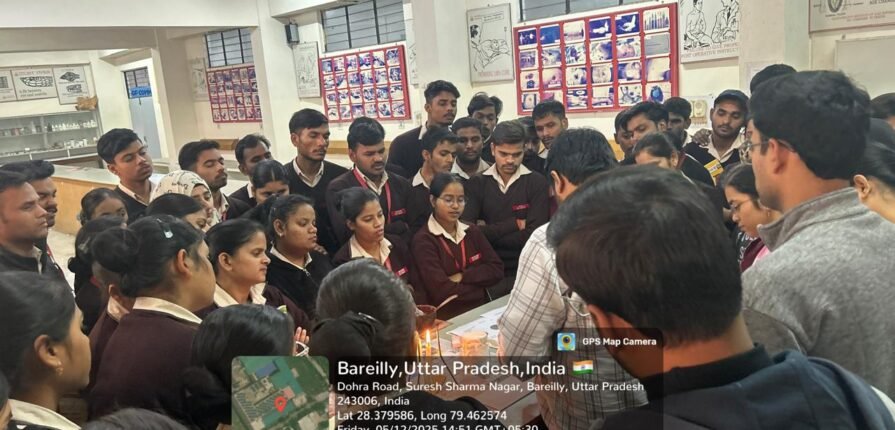
Date: 05/12/2025
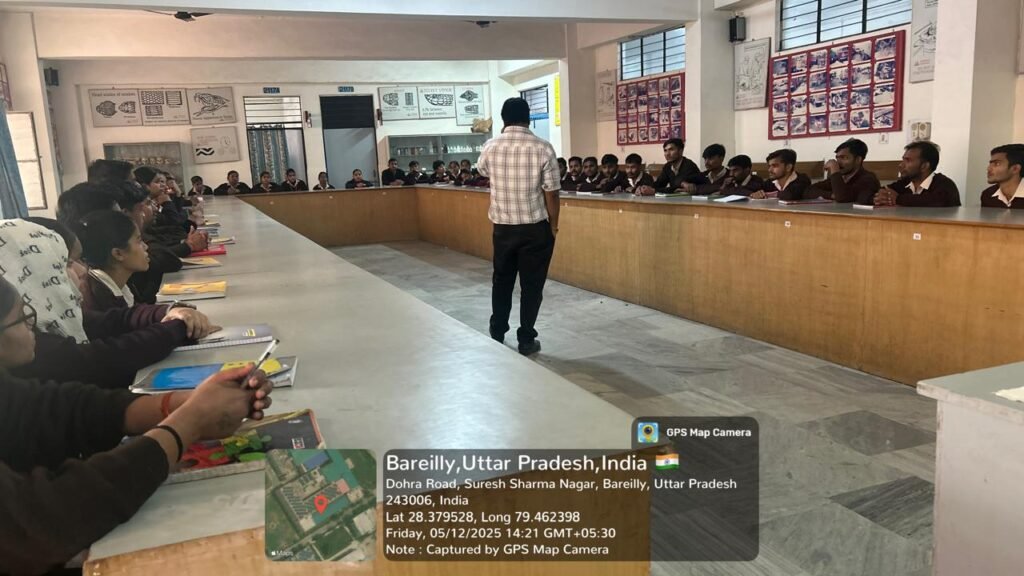
Venue: Forensic department, Rohilkhand Medical College & Hospital, Bareilly
Participants: B.Sc. III year
Time: 02:00 PM to 3:00 PM
Purpose of Visit: To observe medico-legal procedures, autopsy techniques, and understand the role of forensic medicine in criminal investigation
Objectives of the Visit:
- To observe the infrastructure and functioning of the mortuary and autopsy suite.
- To understand the steps involved in medico-legal autopsy and documentation.
- To learn about preservation of viscera, toxicological sampling, and chain of custody.
- To correlate classroom knowledge of forensic medicine with practical application.
Observations:
- Infrastructure & Safety: The mortuary complex was located separately with restricted access and proper ventilation. Personal protective equipment including gowns, gloves, masks, and shoe covers were mandatory before entering.
Autopsy tables were stainless steel with adequate drainage and water supply.
Cold storage chambers were maintained at 2–4°C for body preservation.
Biomedical waste disposal followed color-coded segregation as per guidelines.
- Autopsy Procedure andCase briefing:The medico-legal case history, inquest report, and police requisition were first reviewed.
External examination: Noted height, weight, identification marks, injuries, rigor mortis, post-mortem lividity.
Internal examination: A standard ‘Y’ shaped incision was used. All three body cavities — cranial, thoracic, abdominal — were opened systematically.
Organs were examined in-situ and then removed for detailed dissection. Weight and gross findings of heart, lungs, liver, kidneys, and brain were recorded.
Viscera for chemical analysis were preserved in saturated salt solution and sealed in the presence of police.
- Other Sections Visited Museum:Displayed various weapons, poisons, skeletal remains, and medico-legal specimens with case histories.
Toxicology Lab: Demonstrated preliminary tests for common poisons like organophosphates and alcohol.
Clinical Forensic Medicine: Discussed examination of assault, sexual offence, and age estimation cases.
Documentation: Observed preparation of post-mortem report, injury certificates, and medico-legal forms.
- 4. Learning Outcomes: Understood the importance of accurate documentation and chain of custody in medico-legal cases. Observed how forensic findings correlate with manner of death — natural, suicidal, homicidal, accidental. Recognized the ethical and legal responsibilities of a medical officer during autopsy. Appreciated the coordination between forensic experts, police, and judiciary.
Conclusion
The visit provided practical exposure to the working of a forensic medicine department. It bridged the gap between theoretical knowledge and real-world application of forensic principles. The meticulous nature of autopsy work and its role in delivering justice was clearly evident.
Leave a Reply